Neural Architecture Search for Mammography
Investigation of automatic search methods for neural network hyperparameters (Neural Architecture Search). Application to Mammographic Data
GE Healthcare, WHARe team (Women's Health Applied Research) · Sorbonne Université (IMA)
Abstract
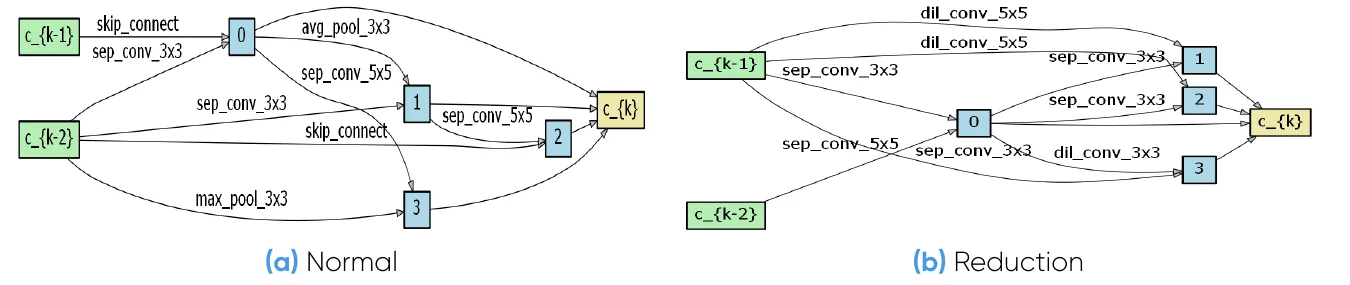
Searching for good neural network architectures and hyperparameters by hand is slow. Neural architecture search (NAS) automates it, but most methods rely on costly evolution or reinforcement learning. We evaluate a gradient-based method, DARTS, and its memory-efficient variant PC-DARTS, for mammogram classification at GE Healthcare.
Cells are searched directly on mammography (DDSM-Patches) and, to test architecture transfer, on a larger context-similar dataset of retinal images; the discovered architectures are then trained from scratch and evaluated, including on a private clinical dataset (CSE).
The searched architecture outperforms the existing model, with 78.05% vs 75.03% validation accuracy on DDSM-Patches and ROC-AUC 0.9243 vs 0.9234 on CSE. A cell searched on 88k retinal images transfers well, reaching ROC-AUC 0.91 on CSE.
Keywords: neural architecture search · AutoML · DARTS · PC-DARTS · mammography · transfer learning
Method
- Search. PC-DARTS (partial channel connections) searches for a normal and a reduction cell on the target data, with an added initialization constraint.
- Build. The network stacks 8 cells: 6 normal and 2 reduction cells.
- Evaluate. The discovered architecture is trained from scratch and results are reported on the validation set.
- Transfer. Cells searched on a larger, context-similar dataset (diabetic retinopathy) are evaluated on mammography.
The search trains for 50 epochs with 16 initial channels and a 75:25 split, sampling channels with K = 2 and freezing architecture weights for the first 15 epochs. The whole search takes around 9 hours on a single NVIDIA Quadro RTX 6000 GPU.
Table 1: Search hyperparameters on DDSM-Patches.
| Hyperparameter | Value |
|---|---|
| Cells | 8 (6 normal, 2 reduction) |
| Initial channels | 16 |
| Search epochs | 50 |
| Train / valid split | 75 : 25 |
| Channel proportion K | 2 |
| Begin epoch (architecture frozen) | 15 |
| Weights optimizer | SGD, lr 0.1, cosine, momentum 0.9, wd 10⁻⁴ |
| Architecture optimizer | Adam, lr 6 × 10⁻⁴, β (0.5, 0.999), wd 10⁻³ |
| Search time | ≈ 9 h on one NVIDIA Quadro RTX 6000 |
Datasets
Table 2: Datasets used
| Dataset | Size | Role |
|---|---|---|
| DDSM-Patches | 5k patches, 500 × 500 | Search and evaluation (public) |
| CSE | 1.3k images | Fine-tuning and evaluation (private) |
| Diabetic retinopathy (Kaggle) | ~88k images | Search for architecture transfer |
| NIH ChestX-ray | 112,120 images | Transfer exploration |
Results
Table 3: Searched architecture vs the existing model
| Dataset | Metric | Searched architecture | Existing model |
|---|---|---|---|
| DDSM-Patches | Validation accuracy | 78.05% | 75.03% |
| CSE | ROC-AUC | 0.9243 | 0.9234 |
Table 4: Evaluation on DDSM-Patches by input resolution
| Model | Validation accuracy |
|---|---|
| 3-ds model (65 × 65 inputs to cells) | 76.74% |
| 2-ds model (125 × 125 inputs to cells) | 78.05% |
Table 5: Architecture transfer: cell searched on diabetic retinopathy
| Evaluated on | Result |
|---|---|
| DDSM-Patches | 76% validation accuracy |
| CSE | ROC-AUC 0.91, 85% validation accuracy |
Key findings
- Search beats the existing model: 78.05% vs 75.03% validation accuracy on DDSM-Patches, and ROC-AUC 0.9243 vs 0.9234 on CSE.
- More input information helps: feeding 125 × 125 inputs to the cells gave the highest accuracy of all experiments.
- Architectures transfer: a cell searched on 88k retinal images reached ROC-AUC 0.91 on CSE, in the same range as cells searched directly on mammography.
Conclusions & limitations
DARTS produces satisfying results on natural images, but generalizing it to medical datasets is still a challenge. DARTS is not hyperparameter-free: it introduces new hyperparameters while eliminating others, the models that generate architectures still need to be hand designed, and learning rate, regularization and optimizer stay outside the search. Architecture transfer, inspired by transfer learning, is a promising approach with larger, context-similar medical datasets.